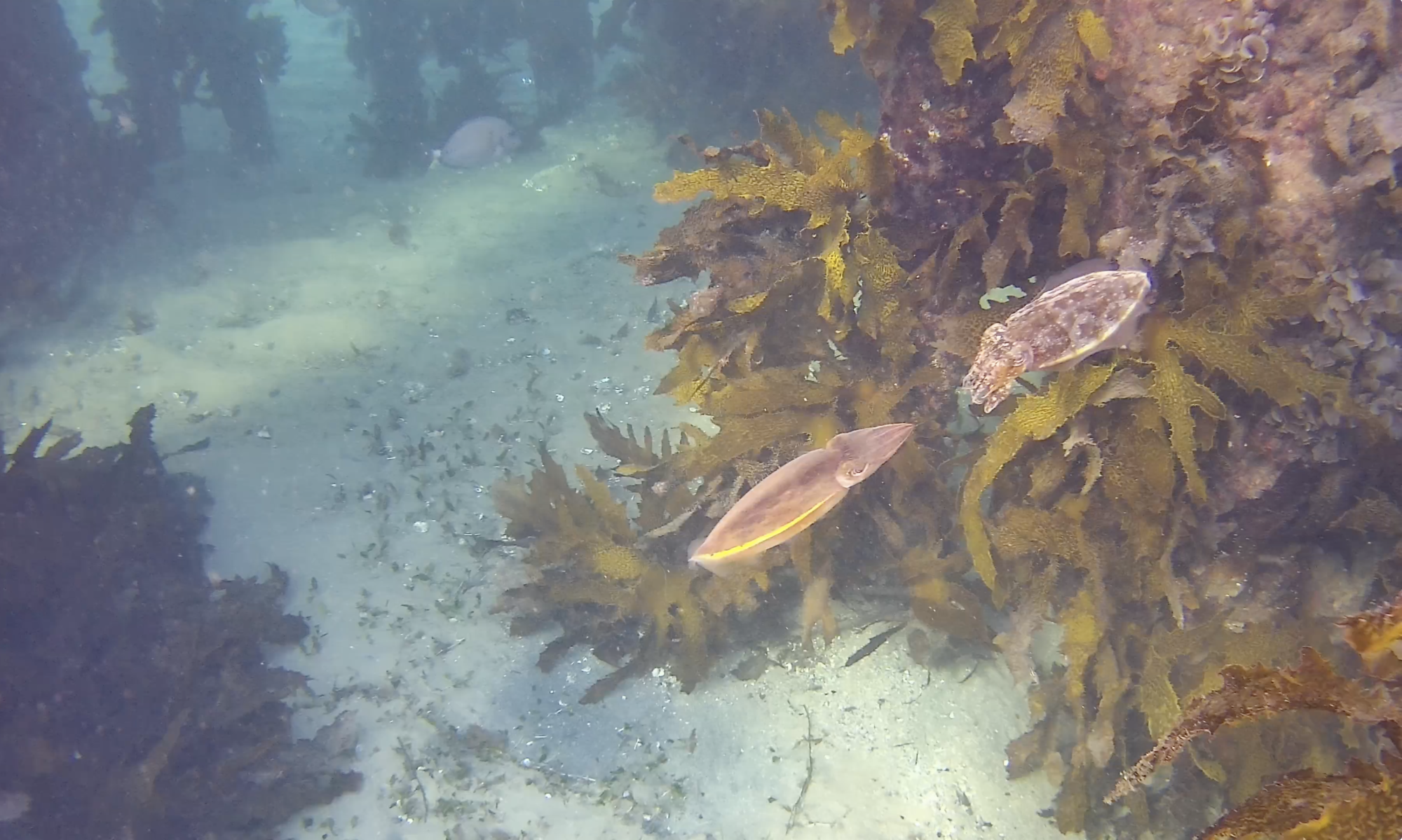

Baby Collosal Squid spotted by ROV SuBastian off South Sandwich Islands

Scientists aboard the research ship Falkor (too) were piloting the ROV at a depth of about 2,000 feet off the South Sandwish Islands when it encountered an elusive squid. The team, and later by several independent experts, identified the squid as a baby colossal squid Mesonychoteuthis hamiltoni), a mysterious deep-sea predator that had never been seen alive in its natural habitat.

Read more at: Miami Herald 15apr25

ROV discovers Borealis Mud Volcano on Arctic Seabed

Scientists from UiT Arctic University of Norway first discovered the Borealis Mud Volcano in 2023 at a depth of 400m (1,300 feet) and have been using ROV Aurora to collect video and samples of gas and sediment from the craters.

ROV Aurora imagery shows anemones, serpudils (tube-worms), hydroids, nudibranchs and octocorals living on the carbonate crusts around the craters, as well as schools of fish like spotted wolffish, redfish and saithe around the carbonate formations.

Full article at: Mongabay.com Feb 2025

Databases of underwater marine debris

The only large publicly available repository of underwater marine debris images is the Deep-sea Debris Database (https://www.godac.jamstec.go.jp/dsdebris), curated by the Japan Agency of Marine Earth Science and Technology (JAMSTEC). Available data contains images of marine debris and various types of marine plants and animals captured in underwater surveys by remotely operated vehicles (ROVs), mainly in the sea of Japan.

Researchers in Croatia and the Netherlands have developed Seaclear Marine Debris Dataset, the first publicly available underwater marine debris dataset in shallow-water environments, annotated for instance segmentation and object detection tasks. Data collection was performed by deploying camera-equipped Remote Operated Vehicles (ROVs) at different sites. A BlueROV2 was equipped with two cameras, a Bluerobotics Low-Light HD Camera and a Paralenz Vaquita, while the SST Mini-Tortuga ROV was equipped with a Smart Security SIP-E323CV camera.

Research paper at: NIH National Library of Medicine

ROVs can aid divers in search & rescue efforts

Underwater ROVs can be deployed to help search & rescue efforts in a variety of situations where the risk is high for divers. With live audio & video, lighting rigs and sonar equipment to assist with navigation and location, ROVs can minimise the risk to divers in difficult environments.

Unfortunate examples include the Titan Submersible search in 2023 and the Bayesian superyacht disaster in 2024

More at: The Conversation 23aug24 and CNN.com 22jun23