Shipping BlueROV2

We just want to remind you all that Blue Robotics has updated their recommendations for shipping the BlueROV2. Remember to:

  • Remove vent during shipment
  • Wherever possible, avoid transporting the ROV in high temperature environments
  • Inspect cable penetrators carefully before each dive, especially after transportation
  • Perform a vacuum test BEFORE EACH DIVE
  • Lift the ROV only from the tether (with strain relief in place). Do not lift from any other cables.

FIFISH V6 firmware upgrades

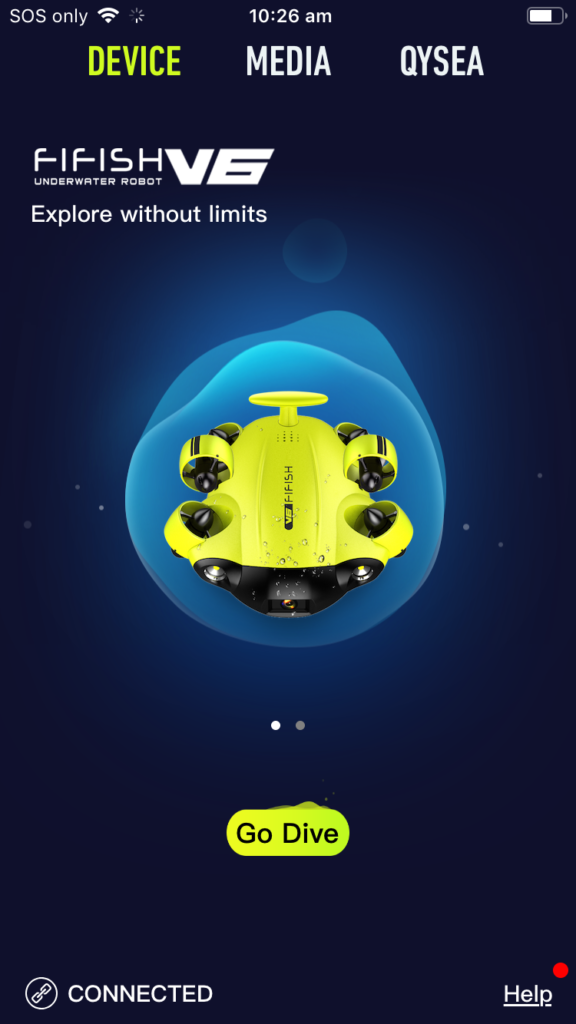
It is good to update your V6 firmware periodically for new app features (like curvature settings), function enhancements, and bug fixes. The FIFISH App will alert you when new firmware updates are available by displaying a red dot next to the Help menu in bottom right corner of FIFISH App main screen (see photo).

Instructions on how to complete firmware updates can be found at: QYSEA support Make sure your devices (mobile phone, remote controller, and ROV) are fully charged before you start the upgrade process.

Remember to recalibrate the V6 gyro/accelerometer and the magnetometer sensors after each firmware upgrade. Again, detailed instructions can be found at: QYSEA support

Fifish V6 Thruster Guards

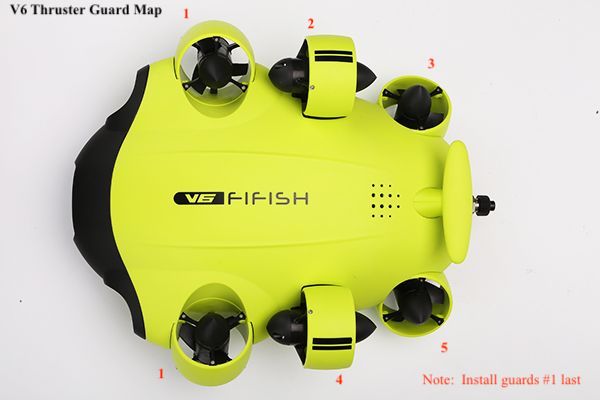
We recommend getting thruster guards to extend the working life of these motors when using the V6 in areas with a lot of weed, debris or fishing line. Installation is quite easy and only requires a small screwdriver.

Tips:

  • Each guard is stamped with a number matching the placement guide above (in red)
  • Install #1 guards last
  • Screw heads will face either up or forward relative to the V6 body
Shipping your ROV

For those travelling with their BlueROV2, Blue Robotics strongly suggests you remove enclosure vent plugs during shipment by air or road, to allow the enclosures to change internal pressure and reduce stress on the penetrators.  Just remember where you packed them for re-installation when you arrive.

Also remember to take extra desiccant (silica gel) bags to put into the electronics enclosure at your destination, to prevent dome fogging during the dive.

Finally, about flying with ROV batteries: it is our understanding that you can fly with one Blue Robotics 18Ahr battery packed in the ROV (obviously, not connected) but you cannot take any 18Ahr spares in the cabin (they ship as hazardous goods cargo only).  Up to two HobbyKing 8Ahr or 10Ahr batteries can be taken as spares in carry-on luggage, only with prior approval of your airline. Each carrier has their own rules about lithium batteries, so call before you arrive at the airport.

The Fifish V6 can ship as is, as long as the ROV tether plug is in place to prevent electrical shorting. The V6 has a 97.2 Watt-hour battery capacity that is under the 100Watt hour limit for passenger plane carry-ons. It is always wise to take a copy of the technical specifications with you, in case you are asked about the equipment.

To calculate the capacity of your batteries: Power capacity = Voltage * Current * Time e.g. Blue Robotics: 266.4 Watt-hour = 14.8 Volts * 18 Amp-hour