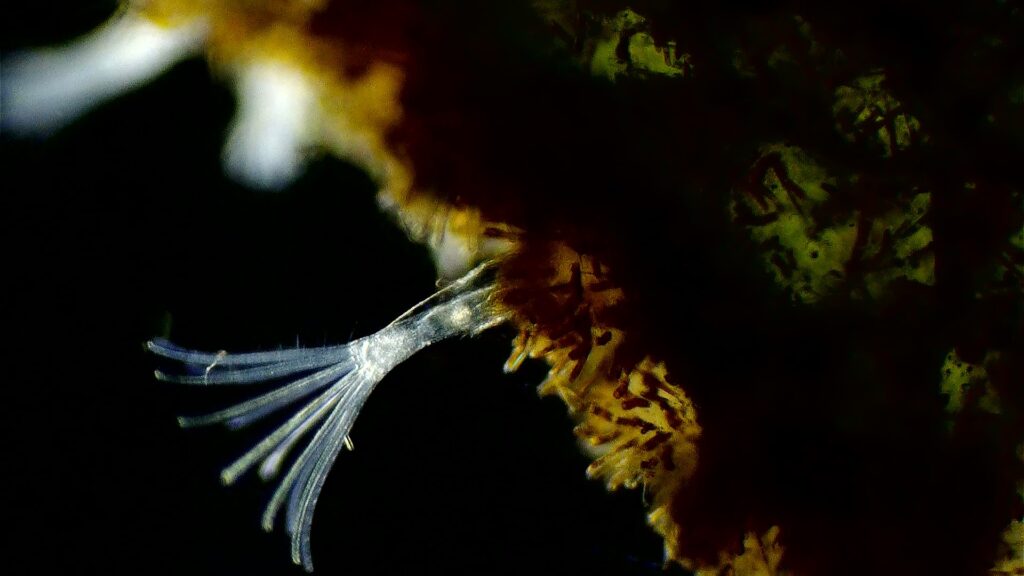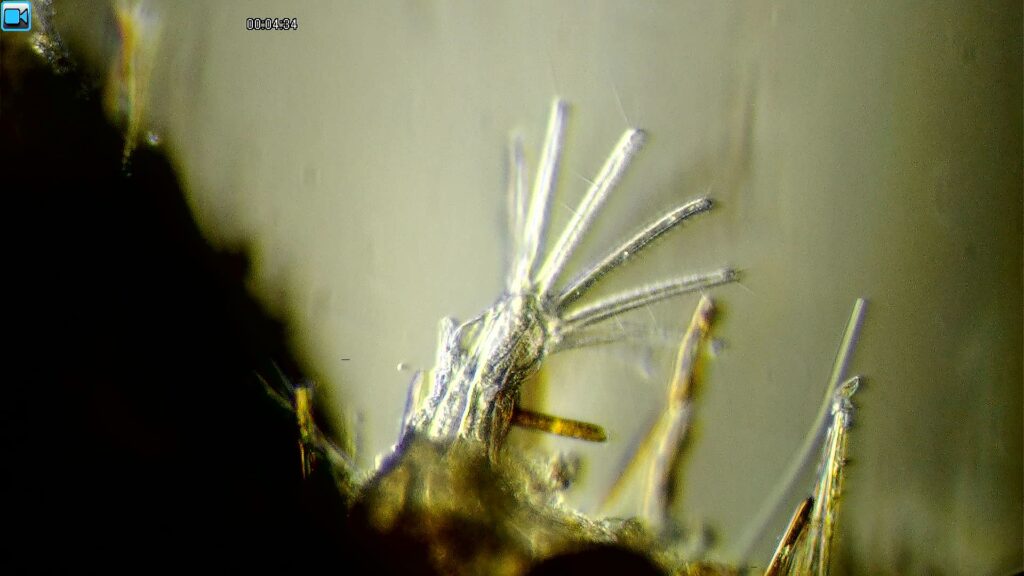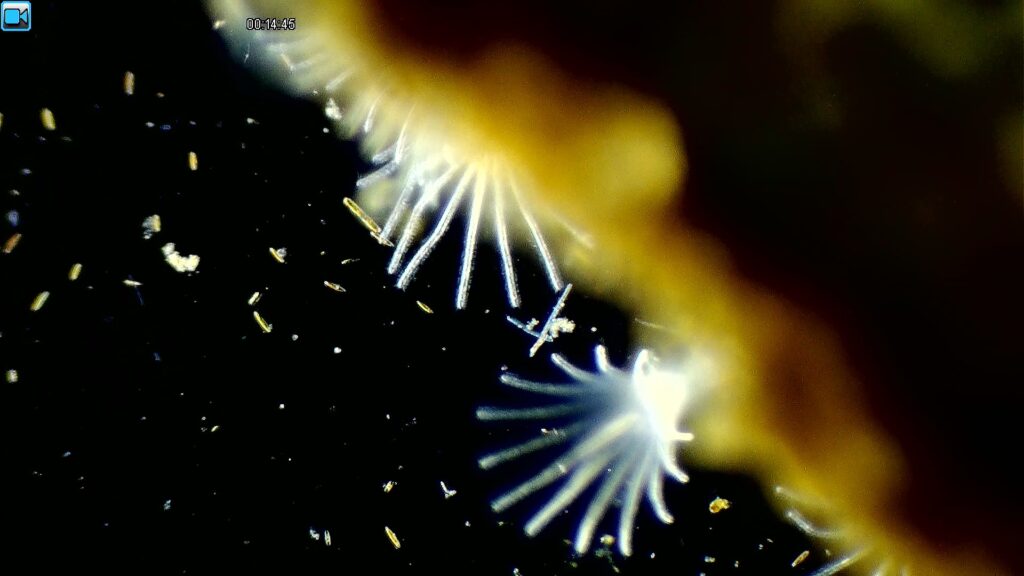

Hydra? Ciliate? Cnidarian?

UnderseaROV has teamed up with AUSI to explore microscopic underwater habitats in the SEA Lab. We are still learning a lot about this minuscule cosmos (there is sooo much to see in each water droplet) and spotted a mystery marine organism on a piece of seagrass that we hope someone out there can help us identify. This creature looks to be part hydra, part ciliate, part cnidarian (jellyfish family)? We have yet to find any nomenclature that fits. Help?

[Update] Huge thank you to our friends Jen Z, Bruno and others connected with the University of Washington’s Friday Harbor Labs, who identified this creature as a bryozoan, specifically from the genus Amathia (formerly known as Bowerbankia, kind of like the Artist Formerly Known as Prince). We so appreciate your help!!

Rare Squid Spotted by ROV

The Schmidt Ocean Institute scientists, using the ROV SuBastian, came across this rarely-seen, otherworldly squid in 2019. This genus, Planctoteuthis, inhabits ocean depths of up to 4,000 meters (13,123 feet) down, almost entirely beyond the reach of the Sun’s rays.

This stunning and delicate genus of squid is largely known from samples hauled up from the depths, and damaged in the process. We’ve only seen Planctoteuthis alive in its natural habitat very rarely, so there’s a lot we don’t know.

For example, scientists have found in the samples features usually only seen in juvenile squids. This suggests that the genus might be neotenic, or slow to mature. We also don’t know the reason for the long, elaborate tails.

However, when a creature doesn’t look like its species, there’s a good bet that it looks like something else. This is called mimicry, and in the animal kingdom it often confers an advantage for avoiding predators. This specific Planctoteuthis is thought to resemble a siphonophore, a composite animal that possesses stinging cells, and flashes light to attract prey.

Planctoteuthis could be hijacking the appearance of a siphonophore to try and attract similar prey, but also to repel the predators that would normally be wary of being stung by a siphonophore.

Full article at: Science Alert 07oct21

Test Rescue Missions

Thales Australia has been working with students at University of Technology Sydney (UTS) as part of the Industry Studio Collaboration Project. Team members recently tested custom ROV control software with some basic underwater manoeuvring and an underwater item-collection challenge using an ROV equipped with a dustpan. Sounds like the next project hurdle will be to implement autonomous behaviour by the ROV so it can identify and collect items without a pilot. Quite a challenge!

Full article at: Thales Test Tank Rescue Mission

Red Scorpion Fish

We spotted this super-camouflaged, stealth predator on a BlueROV2 dive in Batemans Bay NSW this morning.

Dave said the sting from one of these dorsal fins was the most painful experiences he has had… He has since learned that the venom can be denatured with very hot water.

Kelp Holdfasts

Did you know that kelp don’t have roots? They use branching, root-like, gnarled structures called holdfasts to anchor themselves to rocks. Holdfasts don’t carry nutrients or water – they are only for securing the kelp to a rock where it will grow.

Here is a photo of a (yellowish) holdfast that we saw recently on a dive with our modified BlueROV2: