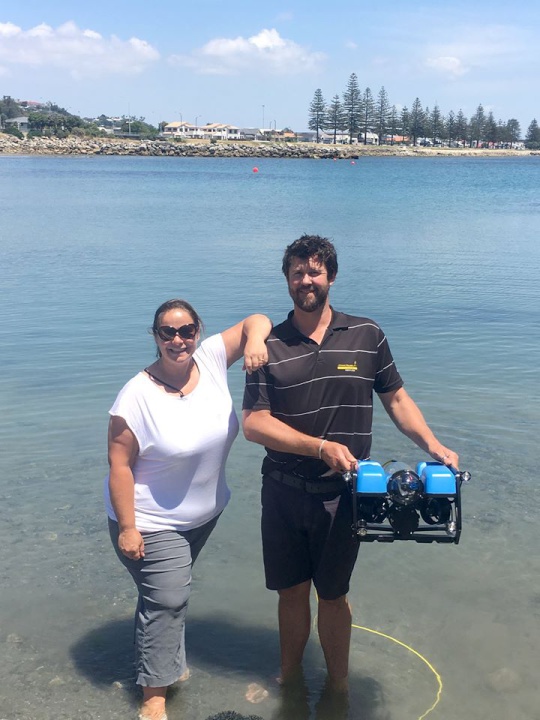
Local Council gets BlueROV2

NZ’s Hawkes Bay Regional Council has their own BlueROV2 to allow their coastal and marine scientists to map local sub-tidal habitats and conduct underwater inspections themselves.  Full article at: Scoop Regional 17may18

HBRC Scientists with

HBRC Science staff Anna Madarasz-Smith and Shane Gilmer with Big Blue

Photo Credit: Scoop Independent News

Rock pool creatures

For those who like playing “Where’s Wally”, can you spot any of the following:

Seastars (likely Meridiastra calcareous)
Elephant snail (Scutus antipodes)
Purple urchin (Heliocidaris erythrogramma)
Barnacles (Cirripedia species)
Limpets
Seaweed and crayweed
Mulberry whelk (Morula marginalba) and other sea snails

Rock Pool, Mona Vale NSW

Fogging fix

Fogging can be a real problem because it interferes with visibility. Humidity and condensation will always be an issue because of air to water temperature differentials, so minimising moisture in the housings is essential. the problem can be minimised with a little effort, especially since we can easily access the BlueROV2 internals. Using one or both of the methods listed below has the optimum outcome for the greatest variety of environmental conditions.

1 – equalise the ROV in dehumidified room: in a small room with a dehumidifier, remove the electronics enclosure vent plug and leave the ROV to equalise for several hours. You may find similar results in a well air conditioned room overnight, depending on relative humidity.

2 – desiccant: use desiccant to remove humidity from the electronics enclosure. We suggest rechargeable, moisture indicating, silica gel, which you can purchase through us or other suppliers.

Enjoy!
Engineers inspect dam with ROV

The US Army Corps of Engineers used a VideoRay Pro4 to inspect a hurricane-damaged dam in Puerto Rico as a pre-dive safety assessment.

“We first used an ROV to give us an idea of the safety conditions below the water, before we were willing to send a diver down there, as well as inspect and record portions of the structure that would not be accessible to one of our divers” said Weston Cross, a Buffalo District Engineer and dive team member. “We were able to determine that the gates were where they were supposed to be, the concrete was in good condition, and there weren’t any obstructions that could foul the diver.”

Full article available at: DVIDS News, 31mar18

Photo by Dr. Michael Izard-Carroll, U.S. Army Corps of Engineers, Buffalo District